Be yourself; Everyone else is already taken.
— Oscar Wilde.
This is the first post on my new blog. I’m just getting this new blog going, so stay tuned for more. Subscribe below to get notified when I post new updates.
Be yourself; Everyone else is already taken.
— Oscar Wilde.
This is the first post on my new blog. I’m just getting this new blog going, so stay tuned for more. Subscribe below to get notified when I post new updates.
If I were to ask a middle or high school teacher one thing, I think I would ask them what is the most important thing to them as a teacher? In other words, why do you teach and what is the most important thing to you about teaching? I think this question is important to me because I want to know if my reasons are legitimate for becoming a teacher and my passion for it. I want to hear the experience and opinion of someone who has been around teaching a lot and see if their reasonings have changed from prior to becoming a teacher. My reason for becoming a teacher is not so much about the education aspect of it as much is it about the personal connection with the student. For myself I would love to coach the sport of track and field as well as teaching at the high school or middle school level. I have the passion because I have seen the way my high school coach who was also a teacher, changed not only my life but others lives who were in trouble and in need. Without him I wouldn’t be successful in school or my sport, without him I wouldn’t even be attending this university and if I could make that impact on even just one student life, I think my career would be a success. Of course, the education portion of teaching is important because that too sets students up for their future. But I believe if you can set a personal relationship with a student and become a role model and someone, they could look up to you would be giving your all to your students. I also feel that students will have more of an incentive to do their work and want to be successful if they have a teacher who feels that same passion and need. Students especially at that age who are just coming into themselves need not only a teacher but a role model and mentor too. That is what is important to me and that is why the answer and opinion that veteran teachers give to me is important because I need that feedback and advice if I am ever going to be successful.
When teaching writing to young students it is important to discuss and assign diverse topics related to social justice. Teaching students to write about diverse and cultural topics will help them grow as writers. It challenges them to think about other topics aside from the standardized subjects that they are used to learning. Also it opens their mind to think about other peoples lives and cultural so they get a more broad understanding of the world. All of this will not only make them more informed people but will also prepare them for life beyond middle and secondary classrooms. Despite all of this there are many challenges that come within teaching social justice and equity. The challenge comes when a teacher must try to incorporate social. justice within the classroom while understanding and respecting everyones beliefs and practices. Students come from all walks of life and many have different topics and beliefs about different social aspects of the world. It is important for teachers to not over step but teach and guide the students between what is right and wrong. Finding a balance within all of this is the biggest struggle and key to making it all work.
Students are not the only ones who carry their own views and opinions about things, teachers also have their own ideas and beliefs. If you can learn to understand and appreciate where they come from and believe then you will teach them appreciate other cultures as well. This is the responsibility of all teachers. In an article from the NCTE called Understanding and Teaching Writing: Guiding Principles, they discuss how writing is embedded in complex social relationships. In the article they state that in order to understand social relationships and promoting social justices teachers must understand the relationships among students with different “group affiliation, identity, and language.” This can becoming challenging for teachers to do it is often hard for people in general to put themselves in someone else shoes but in order to create a healthy an happy classroom experience it is important to talk about and assign topics that may be diverse and cultural. The gap of unknown proportions between what students learn and what teachers try to teach is partly attributable to students diverse social aspects, the connections between these locations and curricular justice, and the wide variety of possible student responses, even when students are similarly socially located. Although the teacher’s goal ,might be to empower students or at least to raise their awareness, teachers might find that you’re making a student in your class particularly uncomfortable, even in places where you wouldn’t expect it. a related set of challenges has to do with teaching about injustices and targeted groups when teachers are, in many ways, privileged. How do teachers strike the right tone? The approach and tone may need to shift depending on the social locations of the teacher and the mix of student in any particular classroom; otherwise, the teacher risks sounding condescending, belittling, or self-righteous.
In order for students to understand and practice other social justices, teachers must assign topics that are real and authentic that are related to these topics. Giving them and example of something is real will allow them to believe it and potentially follow it. In a post by Anne Elrod Whitney called Keeping it Real: Valuing Authenticity in the Writing Classroom, she talks about the challenge of maintaining authenticity in the classroom. Whitney explains that sometimes “often schools glosses over what is most real and immediate, such as a students’ day-to-day experiences and concerns…instead we focus on the writing skills in a disconnected way, having them write “for practice” about topics that are safe, easy, and distant.” This is exactly what teachers try and struggle with when attempting to teach writing social justice. Teachers are often afraid to roll the dice on topic that are controversial and diverse and far too often will go with the topics that are easy and comfortable. When students are engaged in real-world problems, scenarios and challenges, they find relevance in the work and become engaged in learning important skills and content. Students are more likely to engage in the topic when there is a real-world audience looking at their work, giving them feedback, and helping them improve. This is just one critical part of authentic-based learning related to social justice and equity.
Lastly, a challenge in teaching social justice in writing is that writing serves many different purposes. Most of the students that will be writing bout social justices and equity aren’t oblvious to the fact that they exist. As teachers the challenge comes when teaching these students that they have the ability to make a difference in the world. We must empower these students and make sure that they know that their writing and their ideas can make a difference. In a book called Continuing the Journey by Ken Lindbolm and Leila Christenbury on Chapter 9 he discusses the power of empowering students. In the chapter they state that “Speaking out against racism, homophobia, environmental neglect, anti-gun-legislation groups, and others, today’s youth employ social media and, increasingly, mainstream television media to influence national debate. Our English classes and our schools can be an asset to these young people, whether they are finding their voices or refining their message.” Teaching student about these topics will help them be able to change the world. The challenge comes when guiding students to believe that they can do so, believing that they are writers. You can allow students to believe that they are writers if you treat them as writers. Build relationships and connections with your students and get them to believe in what they are writing is true. If teachers do so then their students can change the world.
Teachers should allow their students to write about things that help them step out of their comfort zone. if they do so they will not only grow as writers but as people. if teachers guide them in terms of social justices and equity they will be able to help change the world and make decisions for the better. teachers must acknowledge the challenges that come with teaching social justices but embrace them and face them head on.
Within my experiences during WRT 392 we have learned many ways in which we can help encourage students to believe and trust in their writing. Having students feel encouraged in their writing will help them in a vast majority of ways. The students will feel more inclined to do the assignments which will thus help their writing grow which in turn will allow them to be more prepared for writing beyond high school.
From the NCTE we learned that “writers grow when they have the opportunities to expand upon and not merely transmit content knowledge”. This means allowing and teaching students to have meaning in their writings, giving them opportunities to expand about the things they’re writing about. Giving them in-depth writing experience such as this will allow them to have opportunities to spend time, work on multiple drafts and see how their writing has changed over time.
Another way we have learned to try to engage the students within their writing is the creation the a Teacher-Student Rubric. With a Teacher-Student Rubric students and teachers are involved within a community of feedback with each other. In a community of feedback, teachers become learners too, because they inquire with learners about why writers make the choices they do. This also allows students and teachers to gain a more personal and friendly relationship which can help encourage them and make them feel important and like they were involved in the rubric making process.
Teaching students the different kinds of writing processes will also allow them to think and write like writers more effectively. It is important to let students know that there is NOT just one specific writing process that they need to follow. In order for students to develop their writing and be encouraged about it teachers must allow their students to know this. While it is necessary for teachers to tell their students that there is not just one specific writing process they must inform them of many other possible processes. This includes making an outline, research and many others.
Teachers must also teach students past the test and allow them to having meaningful writing assignments that they can feel engaged and passionate about. This is important because I will set them up and prepare them for writing beyond the high school level. If students are strictly giving standardized based writing assignments they may feel unmotivated to do their writing. But if teachers give the students controversial, cultural and diverse topics these students will feel more inclined to be involved in these assignments.
If teachers can learn and understand how to incorporate these teachings to their students they will allow their students to feel more inclined and more encouraged with their writing assignments. Doing this will let them think, act and write like real writers which will only help them grow.
In chapter 3 of The Six Academic Writing Assignments, Jim Burke discusses the topic of Writing on Demand (WOD) and why it is important for students to be assigned it and what it is exactly. Jim Burke categorizes writing on demand as writing situation where students are given a prompt and are given a specific and set time limit to complete it. Burke states that this writing is important because it allows students to be more creative and it also prepares students for standardized testing writing due to the fact that students will not know the prompt prior to going into the exam.
Burke explains the use of WOD and how teachers can implicate it within the classroom. He encourages teachers to give the students options of free choice writing which allows them to kind of gets the creative juices flowing so they are used to an assignment that is similar to a WOD assignment. Burke highlights that this kind of writing is important due to the fact that it will prepare students in their careers, other classes and other tests.
Another helpful tip is allowing students to prepare for these assignments by planning them. Planning helps students focus their thoughts and organize their on-demand writing piece. This is taught by a step-by-step strategic way, the goal is that through repetition, students will start to plan automatically whenever a writing assignment is given, whether it is a long writing piece or a shorter on-demand piece.
Burke also continues to talk about conferencing with students boosts their self esteem and confidence, which is needed for on-demand writing. Helping each student identify their personalized goals by using a rubric, editing checklist, or revising checklist, and by asking your student to reflect on their writing. I’ve found this helps students find their errors when they’re writing an on-demand piece for which they will have no time for peer editing and revising.
Lastly Burke discusses Self-assessment and reflection help a student to know themselves as a writer, which is beneficial for on-demand writing. In class we talked about how a teacher/student rubric is appropriate and helpful for students and it allows them to fully understand the assignment as well as building relationships with their students. This may be a useful tool in helping students with their self-abasement skills. Students score their own writing and use the document to set goals for their writing improvement. Not only do students fill out the rubric, but they answer a short questionnaire that asks them to identify their strengths, weaknesses, goals, and areas for which they would like teacher assistance. This type of self reflection helps students prepare and improve from one writing piece to the next, regardless of length and time frame given.
The on-demand type of writing is becoming more prevalent in social media, standards based testing, and in preparing students for college and career readiness. One of the four ways teachers can increase students’ aptitude for writing on-demand is by including both longer duration writing with all steps of the writing process, as well as shorter on-demand writing.
As a future teacher of writing it may be hard for some of us to figure out what we can do to make sure we are teaching authentic and informative writing. Students must be able to write for different audiences other than their teachers. In a blog post called Writing in the Work World, they describe how authentic writing is useful and necessary for life beyond middle school and secondary classrooms. This means writing that is going to prepare them for college as well as writing that will make them career ready.
An English journal article by Anne Whitney called Keeping it Real: Valuing Authenticity in the Classroom, she dives into the purposes of authentic writing in the classroom as well as instructions for how teachers so go about teaching and handling authentic writing. One major rule and instruction is allowing students to understand their audience and the goal or reaction that they are trying to receive from their audience. For instance with a blog post it must be important for the students to know what audience they are writing for as well as how they want the audience to interpret their post. If a student is writing an informal blog post but it is meant to be seen as a formal academic post then they have already not understood the task at hand. Whitney also describes how this can be down with a tweet for instance which may seem more simple for the student. Allowing them to make a tweet with the ultimate goal of trying to receive a retweet will allow them to understand the purpose of their writing.
Another example which may be the most important is having students write about things in the world that are outside of the classroom. If you cannot find examples of it then the students should not be writing about it. I believe this is important because it allows students to understand diverse and controversial topics other than their mainstream classroom curriculum. This is important because it allows students to think for themselves and develop their own personality and opinions. In doing this students will feel more excited and engaged in writing and their assignments because this allows them to write about things they care about. When teaching authentic writing it is important for the teachers to give their students the ability to have their own voice while giving them the tools to make their own decisions.
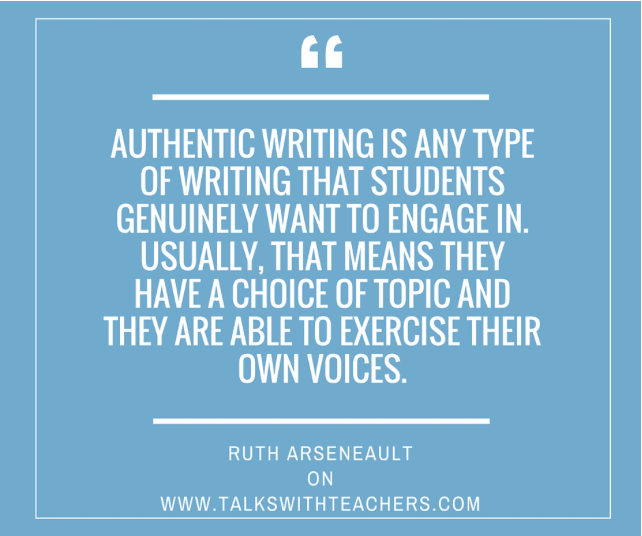
The last and final piece of advice is after allowing students to share their writing asking follow ups questions and getting feedback from the students about what was difficult and how they handled it. For a teacher getting feedback is important for both the students and themselves. In a post by the NCTE called Understanding and Teaching Writing: Guiding Principles, they discuss how a community of feedback allows teachers to become learners because they learn about why their students make the choices that they do. I find this to be a very important topic and principle because these allows the teacher to incorporate it in their lessons and teachings as well as learning more about your students and their person experiences. This allows the student and teacher to gain more of a relationship which in turn only helps the students writing. Writing about topics that are authentic and important as well as having a teacher provides feedback makes authentic writing easier for the student which makes it easier for the teacher to teach it.
As silly as it sounds, before taking WRT 392 I thought there was only one specific way to be taught writing in secondary and middle school classrooms. I assumed that my teachers were doing their job the way that they were supposed to when it came to teaching my peers and I in the correct ways we should write. It was not until I came to Stony Brook as well as taking this class that I realized that teachers and schools have been setting children up for failure and I was a product of this.
My thinking of teaching has been expanded since taking this class, my knowledge about teaching writing has changed as well as my mentality in how to tackle each day as a future teacher of writing and English. As I previously mentioned I believed that my teachers were doing the most that they could have when it came to teaching my peers and I. The sad reality was that those teachers, like many others, are only teaching students to pass the exams and tests. They do not actually help students expand their knowledge in writing and are often setting them up for failure in college and beyond. One of the most popular teaching styles when it comes to teaching writing in high school is known as: “The Five Paragraph Essay” which is an essay that is conducted of 5 paragraphs which include and introduction, three body paragraphs, and a conclusion. This is the most standard model that students are taught in high school when it comes to writing anything in class. Since taking this class I have learned that there are a plethora of different ways and styles that are necessary to be taught in middle and secondary classrooms that are often not taught.
The Template Gap in writing is one of many different “gaps” that occur in middle and secondary classrooms. Since I plan to become a future teacher I believe it is important to recognize the problems that occur in teaching writing and make sure that I do a much better job in teaching my future students. This gap is one that resonates with me and is as well as one that I believe is very important. The Template Gap explains how the standard five paragraph writing model is not affective when it comes to college level writing and beyond and that these scenarios provide much more complex writing structures and styles. Students should not determine paragraphs and sentences by their length but by the meaning of the content within them. Teachers and schools teach this method in order for students to pass the test but is our responsibility to teach the students past the test. This means we do everything we can so that they can pass but also incorporating other diverse topics and methods so they are truly ready for real world writing. This has challenged me ti make sure I make more of an effective effort of incorporating different cultures and styles in my lessons.
Another crucial element of my teaching that I would like to include is the element of feedback to my students. According to one of the principles by the National Council of Teachers of English, having a community of feedback in the classroom is good for not only the students but the teachers as well. This is important because this allows teachers to learn why their students write in the ways that they write and do the things that they do. In turn it allows teachers to build a better bond with their students which may allow them to feel more incentive to do the assignments and work. Having a good relationship with as many students as you can is important to the success of these students. Not every student learns the same and there are many different ways to teach different students the same thing. In a community of feedback, teachers can learn what works for each student and individualize this teachings for each student. These points and teachings have made me challenge myself, learning this and learning just how poorly students are taught these lessons I want to make it my goal to incorporate these teachings in my lessons and classroom as much as I can.

In reading the article they explain the types of challenges and differences that people encounter from the writing that they were taught in school compared to the writing that they do now. The people who wrote the blog discussed how they asked people in their lives to show some examples of their writing. Although they were impressed with the amount of variety they did notice a common problem. All of the writing was different from what these writers were previously taught in school. In the blog they stated that a challenge in teaching students the correct and effective writing was far different from the type of writing they used. They noticed that the samples that were collected were very different from the types of samples that these teachers taught their students in school and that many of the students would not be able to list this much variety. That brings awareness to the fact that students are not nearly taught enough variety of writing in school as they should have and thus sets them up for failure beyond the K-12 level. The concerns that come with that are that even if teachers want to teach students the correct and effective way to write, the standardized testing within schools does not allow the teachers to do so. Teachers often how to “teach the test” rather than teaching their student curriculum that is going to help them succeed beyond the testing. to be an effective writing teacher it is necessary that we encourage and develop diversity within the classroom and within their writing. In the blog it states that in order for children to be effective in writing it is our duty to give them opportunities to “write for real audiences in authentic genres.” Doing this as well as moving away from writing that is mainly centered around the test will allow students to have the proper tools and skills to be successful at the collegiate level and beyond and it is our duty as future teachers to try to enforce this among our students.
After reading all of the known high school gaps I was shocked to see that almost every single one that I read was something that I experienced in high school. I recall the style gap resonating with me the most however though. Writing structured essays in school no matter what class I was in the always taught us to compose each paragraph of five sentences, no more and no less, anything other than five would result in the students receiving points off on the assignment. Like the Style Gap states our school never focused on teaching the students that each paragraph of the essay is determined by the meaning of the paragraph itself not how many sentences are in it. It was not until I got to college that I had the realization that I could use more or even less then five sentences in my papers and essays to get my point across. It was a struggle and I felt so silly to believe that the way I was taught in high school was ever the right way to be taught on how to write an essay. Looking back from where I was to where I am now it is amazing to see how much my style in writing paragraphs and essays has truly grown from only a few years ago.
This is an example post, originally published as part of Blogging University. Enroll in one of our ten programs, and start your blog right.
You’re going to publish a post today. Don’t worry about how your blog looks. Don’t worry if you haven’t given it a name yet, or you’re feeling overwhelmed. Just click the “New Post” button, and tell us why you’re here.
Why do this?
The post can be short or long, a personal intro to your life or a bloggy mission statement, a manifesto for the future or a simple outline of your the types of things you hope to publish.
To help you get started, here are a few questions:
You’re not locked into any of this; one of the wonderful things about blogs is how they constantly evolve as we learn, grow, and interact with one another — but it’s good to know where and why you started, and articulating your goals may just give you a few other post ideas.
Can’t think how to get started? Just write the first thing that pops into your head. Anne Lamott, author of a book on writing we love, says that you need to give yourself permission to write a “crappy first draft”. Anne makes a great point — just start writing, and worry about editing it later.
When you’re ready to publish, give your post three to five tags that describe your blog’s focus — writing, photography, fiction, parenting, food, cars, movies, sports, whatever. These tags will help others who care about your topics find you in the Reader. Make sure one of the tags is “zerotohero,” so other new bloggers can find you, too.

 Jayson's Blog